
Lost in Tender Translation? A Plain-English Guide to Procurement Acronyms
Public procurement is full of acronyms that can make even experienced bidders pause and double-check. RFQ, PIN, DPS, ITT — they’re everywhere, yet rarely explained in plain English. Whether you’re new to bidding or just want a quick refresher, this guide breaks down the most important tender terms you’ll encounter, what each one actually means, and why they matter when deciding how (and whether) to bid.
Early market notices (before a tender even drops)
These are signals that something is coming — useful if you want a head start.
PIN – Prior Information Notice
· What it is: A “heads-up” published by a contracting authority.
· Purpose: To tell the market they plan to buy something in the future.
· Why it matters:
o Lets suppliers prepare early
o Sometimes shortens later tender deadlines
· Important: A PIN is not a tender — you can’t bid yet.
PME / Market Engagement / Market Consultation
· What it is: Informal engagement with suppliers.
· Purpose: To test the market, shape requirements, or assess feasibility.
· Your role: Give feedback, attend supplier days, answer questionnaires.
· Bonus: You can influence the final tender if done well.
Tender & procurement document types
These are the formal routes to contract.
RFQ – Request for Quotation
· Used when: Requirements are clear and risk is low.
· Focus: Price, with minimal technical evaluation.
· Typical for commodities & low-value purchases
· Outcome: Usually awarded to the lowest compliant bidder.
RFI – Request for Information
· What it is: Information-gathering exercise.
· Purpose: To understand supplier capabilities.
· Important:
o No contract awarded
o Often precedes an RFP or ITT
RFP – Request for Proposal
· Used when: The buyer wants solutions, not just prices.
· Focus: Technical approach + quality + price.
· Typical for services and complex projects
· More flexible than an ITT.
ITT – Invitation to Tender
· Most formal tender type
· Used when: Requirements are fully defined.
· Evaluation: Strict scoring against published criteria.
· Important:
o Little room for negotiation
o Deviations can lead to disqualification
Frameworks & dynamic systems: These are longer-term buying structures.
Framework Agreement
· What it is: A list of approved suppliers for a period (e.g. 2–4 years)
· Not a guarantee of work
· Contracts awarded via:
o Direct award
o Mini-competition
· Key risk: If you miss the framework tender, you’re locked out.
DPS – Dynamic Purchasing System
· Like a framework, but more flexible
· Key differences:
o Always open to new suppliers
o Fully electronic
· Best for:
o SMEs
o Fast-moving or commoditised markets
· Bidding: Suppliers apply to join and then bid on call-offs.
Multi-stage procedures: Used for complex or high-risk procurements.
PQQ – Pre-Qualification Questionnaire
· Purpose: Shortlist suppliers.
· Checks:
o Financial standing
o Experience
o Compliance
· Often replaced by: SQ (Selection Questionnaire)
SQ – Selection Questionnaire
· Modern version of PQQ
· Standardised in many jurisdictions.
· Pass/fail in most cases.
· Restricted Procedure
· Stage 1: SQ shortlist
· Stage 2: ITT to selected bidders
· Used when: Buyer wants to limit bids to serious players.
Competitive Dialogue
· Used when: Buyer doesn’t know the best solution.
· Process: Dialogue - final tender.
o Common for:
o Infrastructure
o IT transformation
· Very resource-intensive.
Award & pricing terms
MEAT – Most Economically Advantageous Tender
· Not just cheapest
· Scores based on:
o Price
o Quality
o Social value / sustainability
o Common weighting: 60/40 or 70/30 (quality/price)
Call-off Contract
· What you actually deliver under
· Issued under a framework or DPS.
BAFO – Best and Final Offer
· Final chance to improve pricing or quality.
· No negotiation after this.
Compliance & risk terms
Clarification Questions (CQ)
· Formal questions during tender.
· Answers shared with all bidders (anonymised).
Standstill Period
· Mandatory pause before contract signature.
· Allows unsuccessful bidders to challenge.
Abnormally Low Tender (ALT)
· Price looks too good to be true.
· Buyer must ask you to justify it
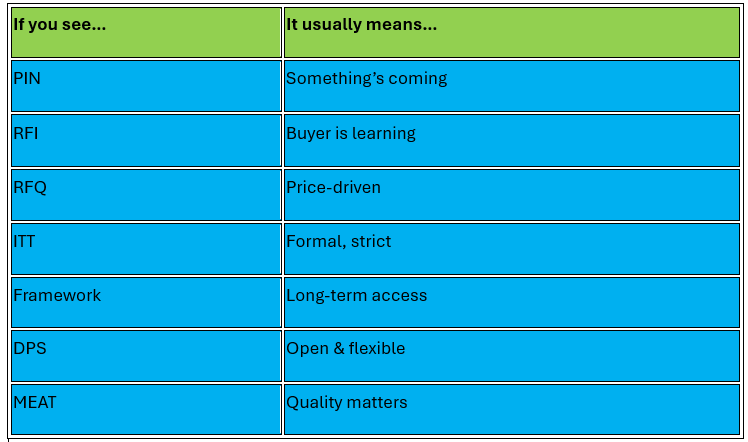
Quick Mental Map of Procurement Terms