
The Procurement Act 1 Year On: Emerging Themes and Key Trends for Suppliers
The Procurement Act came into force in Feb 2025, so we are now a year into the changes. It was the most significant reform to UK public procurement law in decades, replacing the retained EU regime with a new UK-designed system. Let’s remind ourselves of the main objectives:
Simplifying and modernising procurement processes.
Increasing transparency and data quality across public contracts.
Supporting SMEs (small and medium-sized enterprises), VCSEs and wider participation.
Embedding strategic policy priorities such as social value, innovation and economic resilience into procurement.
Introducing the Competitive Flexible Procedure as a standard selection route.
Data, Transparency and Centralisation
One of the Act’s most tangible early impacts has been the improvement in procurement data quality and accessibility. For the first time there is a standardised, centralised publication of procurement notices covering planning, tendering and contract implementation. This makes contract opportunities and lifecycle data far easier to track, which brings more visibility of upcoming opportunities, a single point of truth for key procurement data and easier benchmarking and competitive intelligence.
Rise of Competitive Flexible Procedures
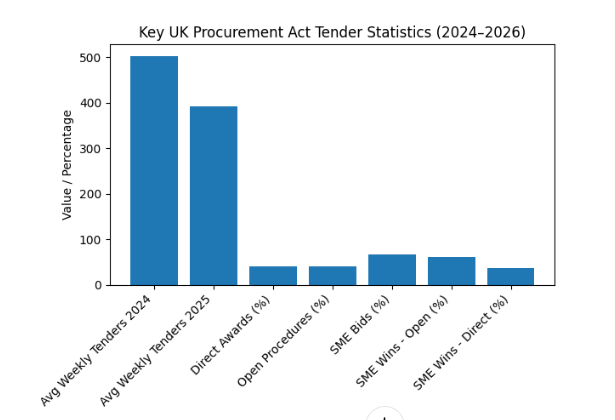
The Act’s Competitive Flexible Procedure (CFP) has become an important trend. This selection method is being used increasingly — particularly in construction, business services and IT — and now accounts for a meaningful share of published tender notices by value.
Supplier implications?
CFP tends to be outcomes- or innovation-focused and may require different proposal approaches (e.g., pitched solutions, iterative evaluations).
Smaller and agile suppliers can gain advantage if they can showcase value through innovation rather than lowest cost.
Increased Focus on SME Engagement and Social Value
A core policy priority under the new regime has been reducing barriers for SMEs and promoting local economic growth. Government departments must set three-year SME spend targets, and contracting authorities must do everything possible to remove barriers to smaller suppliers.
Practical supplier takeaways?
Contracts and submission documents are more SME-friendly.
Contract notices increasingly expect bidders to explain social, environmental and economic value.
Payment terms of 30 days from authorities to main suppliers are clearer and more consistent.
Stronger Accountability and KPIs
Under the Act, authorities must publish Key Performance Indicators (KPIs) for larger contracts (e.g., over £5m) and assess suppliers annually against them, with mandatory publication of performance notices.
Impact on Suppliers?
Contract performance reporting is more important than ever. Don’t overpromise at the tender stage!
Poor performance ratings (even if contested) can be publicly visible and affect future competitiveness.
Data-driven contract management becomes part of the commercial offering, not just compliance.
Debarment and Exclusion Risks
A centralised Debarment List has been introduced under the new regime. Suppliers can be excluded from all UK public procurement for up to five years if they are debarred following investigation.
Key things to watch:
Mandatory and discretionary exclusion grounds remain — compliance and risk management is really important
Supply-chain due diligence and ethical risk frameworks are now central to risk mitigation.
What Suppliers Should Be Aware Of
Here’s what suppliers, especially SMEs should prioritise in their response to the new regime:
Registration and Digital Access
You must register on the UK’s Central Digital Platform (CDP) to participate in tenders; even past registration (e.g., Find a Tender) doesn’t carry over.
Tailored Bid Strategies
Competitive Flexible Procedures often require innovative, outcome-oriented bids (not just lowest price).
Demonstrate delivery capability with measurable KPIs and social value metrics.
SME and VCSE Positioning
Highlight social value, environmental benefits and economic contributions in tenders — this is now part of core evaluation.
Quality and clarity in bids matter more than ever for smaller organisations.
Performance and Risk Readiness
Track contract KPIs and be ready for publicly visible performance reporting.
Maintain robust compliance frameworks to avoid exclusion or debarment risks.
Emerging Themes and Future Direction
Even in its first year, the Act signals a decisive shift in public procurement from transactional to more strategic. Procurement is now explicitly positioned as a driver of economic growth, job creation, and climate and social value outcomes. At the same time, the regime is accelerating digital transformation and embedding transparency, enabling more data-driven scrutiny and performance management. Crucially, the framework is structurally more SME-inclusive, lowering barriers to entry while raising the bar on capability — creating meaningful opportunity for agile suppliers prepared to compete on quality, compliance, and demonstrable value.
Quick Mental Map of Procurement Terms